
Most cold email advice online is written for SaaS companies targeting enterprise buyers. The templates are long. The subject lines are clever. The CTAs ask for "a quick 30-minute discovery call."
None of that works particularly well for agencies targeting local businesses.
A restaurant owner reading their email at 7am before opening is not a corporate buyer with a structured vendor evaluation process. They are a busy person who will decide in three seconds whether your email is worth their time. The templates that work for them look very different from the templates that work for enterprise outreach.
This guide covers the actual templates, frameworks, and subject line strategies that are producing replies for agencies targeting local businesses in 2026 — along with the reasoning behind each choice.
The Fundamental Rule: Observations Over Pitches
Before looking at any template, understand the principle that separates high-converting cold email from low-converting cold email for local businesses:
Lead with an observation about their business. Not a pitch about your agency.
A pitch opens with what you do and why they should care. An observation opens with something you noticed about them — and implicitly demonstrates that you actually looked at their business.
Local business owners are bombarded with pitches. They are almost never contacted by someone who actually reviewed their specific business before reaching out. An observation-based email stands out because it is rare.
The observation does not have to be profound. "I noticed your Google Business Profile is missing a booking link" is specific enough. "Your last five Google reviews mention slow response times — that is usually fixable with a simple process" is better. "You are ranking 7th on Google Maps for [search term] even though your reviews are stronger than two of the businesses above you — there is a clear reason for that" is the best.
Each of those observations says the same thing implicitly: *I spent 60 seconds on your business before contacting you.* That alone separates you from 95% of the cold outreach hitting their inbox.
Template 1: The Google Ranking Observation (For SEO/Local Marketing Agencies)
Target: Any local business with a Google Business Profile
Subject line options:
- "[Business name] — ranking question"
- "Why [Competitor] is ranking above you on Google Maps"
- "Quick observation about [Business name]'s Google listing"
Hi [First Name],
I was doing some research in [City] on [Industry] businesses and came across [Business Name].
Quick observation: you are currently ranking [position, e.g. 6th or 7th] on Google Maps for "[main search term, e.g. dentist in Manchester]" — but your reviews are actually stronger than at least two of the businesses above you.
The gap is almost always fixable. There are usually 3–4 specific changes to the Google Business Profile and the website that move businesses into the top 3 results for searches like that.
I have put together a brief overview of what those are for [Business Name] specifically. Worth a look?
[Your name] [Agency name]
Why this works:
- Opens with a specific, verifiable observation
- Names a competitor implicitly (they are curious who is above them)
- Offers a specific outcome (top 3 ranking), not a vague benefit
- The CTA is low friction — "worth a look?" is much easier to say yes to than "book a 30-minute call"
- It is short — under 100 words
Follow-up if no reply (Day 4):
Hi [First Name],
Following up on my note from [Day]. I did put together that overview of the ranking gaps for [Business Name] — happy to send it over if useful.
The short version: the businesses currently outranking you on "[search term]" have weaker reviews but stronger profile optimisation and citation consistency. Both are fixable.
Happy to share the full breakdown — just let me know.
[Your name]
Template 2: The Review Pattern Observation (For Reputation/Review Management Agencies)
Target: Local businesses with a pattern in their recent reviews (common complaint, missing response, declining rating)
Subject line options:
- "Something I noticed in [Business name]'s reviews"
- "[Business name] — reviews question"
- "The pattern in your recent Google reviews"
Hi [First Name],
I came across [Business Name] while looking at [Industry] businesses in [City].
I noticed something in your recent reviews: [specific observation — e.g. "three of your last five reviews mention wait times" or "you have 63 reviews but no responses in the last 4 months" or "your rating has dropped from 4.6 to 4.1 over the past year"].
For most businesses, that pattern is a signal of something specific — and it affects both how Google ranks you and how new customers decide whether to contact you.
I work with [industry] businesses on exactly this. Worth a 5-minute conversation to explain what I think is happening and what it would take to reverse it?
[Your name] [Agency name]
Why this works:
- The observation is specific and personal — it demonstrates you read their reviews
- It frames the pattern as a solvable problem, not a criticism
- "5-minute conversation" is a lower commitment ask than a full discovery call
- It positions you as someone with a specific diagnosis, not a generic marketing pitch
Template 3: The Website Observation (For Web Design/Conversion Optimisation Agencies)
Target: Local businesses with a weak website — slow load times, poor mobile experience, no clear CTA, outdated design
Subject line options:
- "Quick question about [Business name]'s website"
- "[Business name] — website observation"
- "What I noticed on [Business name].co.uk"
Hi [First Name],
I was reviewing websites for [Industry] businesses in [City] this week and looked at [Business Name]'s site.
A few things stood out:
- [Specific observation 1 — e.g. "The site takes 6.2 seconds to load on mobile — Google's threshold for ranking penalty is 3 seconds"]
- [Specific observation 2 — e.g. "There is no click-to-call button visible on the homepage on a mobile device"]
- [Specific observation 3 — e.g. "The contact form is buried 4 scrolls from the top — most visitors never reach it"]
Each of those is a lead that contacts a competitor instead.
I fix these specifically for [Industry] businesses. Happy to send you a brief breakdown of what each fix would involve — no commitment, just useful information?
[Your name] [Agency name]
Why this works:
- The bulleted observations are hyper-specific and verifiable — the prospect can check them immediately
- Each observation is connected to a real consequence (lost lead, Google ranking)
- The CTA offers information, not a sales meeting
- The message demonstrates technical knowledge without being jargon-heavy
Template 4: The Social Media Presence Gap (For Social Media/Content Agencies)
Target: Local businesses with weak or inactive social media relative to their competitors
Subject line options:
- "[Business name] — social media question"
- "What [Competitor] is doing on Instagram that you are not"
- "Quick observation about [Business name]'s online presence"
Hi [First Name],
I was looking at [Industry] businesses in [City] on Instagram this week for some research I am doing.
[Business Name] last posted [X weeks/months ago] — meanwhile, [Competitor Name] has been posting 4–5 times a week and is getting consistent engagement from local customers.
I am not saying social media is the most important thing for your business. But for [Industry], the businesses that show up consistently online are the ones that new customers find when they search before visiting.
I help [Industry] businesses in [City] maintain a consistent presence without the owner having to think about it. Would it make sense to send you a quick overview of what that looks like?
[Your name] [Agency name]
Why this works:
- Names a specific competitor (creates urgency and relevance)
- Acknowledges the potential objection ("I am not saying social media is the most important thing") which builds trust
- The offer ("without the owner having to think about it") speaks to the real pain — not the desire for more content, but the desire to not have to deal with it
Template 5: The Paid Ads Opportunity (For PPC/Paid Media Agencies)
Target: Local businesses not running Google Ads in a market where competitors are
Subject line options:
- "Your competitors are running Google Ads — you are not"
- "[Business name] — paid search question"
- "Quick observation about [Industry] ads in [City]"
Hi [First Name],
I ran a quick search for "[Service] in [City]" on Google.
Four of your competitors are running paid ads — [Name 1], [Name 2], and [Name 3] are all at the top of results before any organic listings. [Business Name] does not appear until the organic results below.
For searches like this, the top 4 results (the ads) capture roughly 65% of the clicks. The organic results share the remaining 35%.
I work with [Industry] businesses on Google Ads campaigns specifically. Happy to send you a brief on what a campaign for [Business Name] would look like — including estimated cost per lead and what the current competitive landscape in [City] means for your likely results?
[Your name] [Agency name]
Why this works:
- Leads with factual competitive observation — not a pitch
- Uses real data (65% of clicks) to make the consequence concrete
- The CTA offers a personalised brief, which delivers value before asking for anything
Subject Line Strategy for Local Business Cold Email
Subject lines for local business outreach should follow one principle: be specific to their business, not generic about your service.
High performing:
- "[Business name] — quick question" (non-threatening, personal)
- "Something I noticed about [Business name]" (curiosity-based, personal)
- "Why [Competitor] ranks above you on Google Maps" (pain-based, named competitor)
- "[Business name]'s website — 3 things I noticed" (specific, implies value)
- "Your [Industry] competitors are running ads — you are not" (urgency, factual)
Low performing:
- "Digital marketing services for local businesses"
- "Grow your business with SEO"
- "Free marketing audit for [Business name]"
- "Can we help [Business name]?"
The difference is specificity. The high-performing subjects are about something the prospect has. The low-performing subjects are about something you offer. Recipients care about themselves, not about your services.
The Four-Step Follow-Up Sequence
Most agencies send one email and stop. The data is clear: the majority of replies to cold email sequences come after the first message. A structured four-step sequence is the minimum for meaningful results.
Email 1 (Day 1): The personalised observation email (templates above)
Email 2 (Day 4): Add one specific piece of value — a statistic, a case study from a similar local business, a quick insight about their market. Keep it under 80 words.
Email 3 (Day 9): A different angle. If Email 1 was about Google ranking, Email 3 might be about their reviews or their website. A new observation from a new direction.
Email 4 (Day 15): The honest close-out. Something like: "I have reached out a few times about [topic]. I do not want to keep emailing if the timing is not right or if this is not relevant. If it is worth a quick conversation, the easiest way is just to reply with a good time — or I can leave you to it. Either way, no hard feelings."
This final email consistently generates replies — often from prospects who saw the previous emails and kept meaning to respond. The "permission to say no" framing reduces friction and often converts people who were on the fence.
Personalisation at Scale: How to Do It Without Spending All Day on Research
True personalisation — a unique observation per prospect — does not have to mean an hour of research per email. The most efficient approach:
Step 1: Build the list with Google Maps and Apollo/Hunter (see the full process in: Why Cold Outreach Is the Most Important Growth Channel for Agencies Serving Local Businesses)
Step 2: Create a research checklist: for each contact, spend 90 seconds checking their Google Business Profile (review count, last activity, photos, categories), their website (mobile speed via PageSpeed Insights, CTA clarity), and their social media (last post date, engagement). Note 1–2 specific observations.
Step 3: Write the observations into a CSV column alongside the contact data ("personalisation notes"). This column feeds the personalised first line of the template.
Step 4: Use your email sequencing tool (Instantly, Lemlist, Smartlead) to merge the personalisation notes into the template, creating an email that reads as individually written.
With practice, the research step takes 60–90 seconds per prospect. A researcher working part-time can process 40–60 prospects per hour. At that rate, 500 personalised contacts can be prepared in a week.
What to Do When They Reply
A reply — even a neutral or negative one — is a win. Most replies fall into four categories:
"Interested — tell me more" Reply within the hour. Keep the next message short. Give one concrete piece of value (the breakdown, the audit, the case study you mentioned). Propose a specific call time.
"Not interested right now" Acknowledge, thank them, and ask: "Out of curiosity — is there a timing issue, or is it more that this is not relevant at all?" This question converts roughly 15–20% of "not interested" replies into a future conversation.
"We already work with someone" "Good to know — no need to switch anything. I'm always curious though: is there anything about what you're getting now that you'd want to be different?" This question identifies dissatisfaction with existing providers and opens the door to a future relationship.
"Remove me from your list" Remove them immediately. Mark in CRM. Do not follow up. This prospect is not worth pursuing and respecting the request is non-negotiable.
The Automation That Makes This Scalable
Manual cold outreach at the volume needed for consistent results is a full-time job for the agency founder — which is exactly the reason most agencies give up on it.
The solution is automation infrastructure:
- Sequence automation (Instantly, Smartlead, or Lemlist) handles multi-step email sending, follow-up timing, and reply detection
- Inbox rotation ensures high deliverability across multiple sending domains
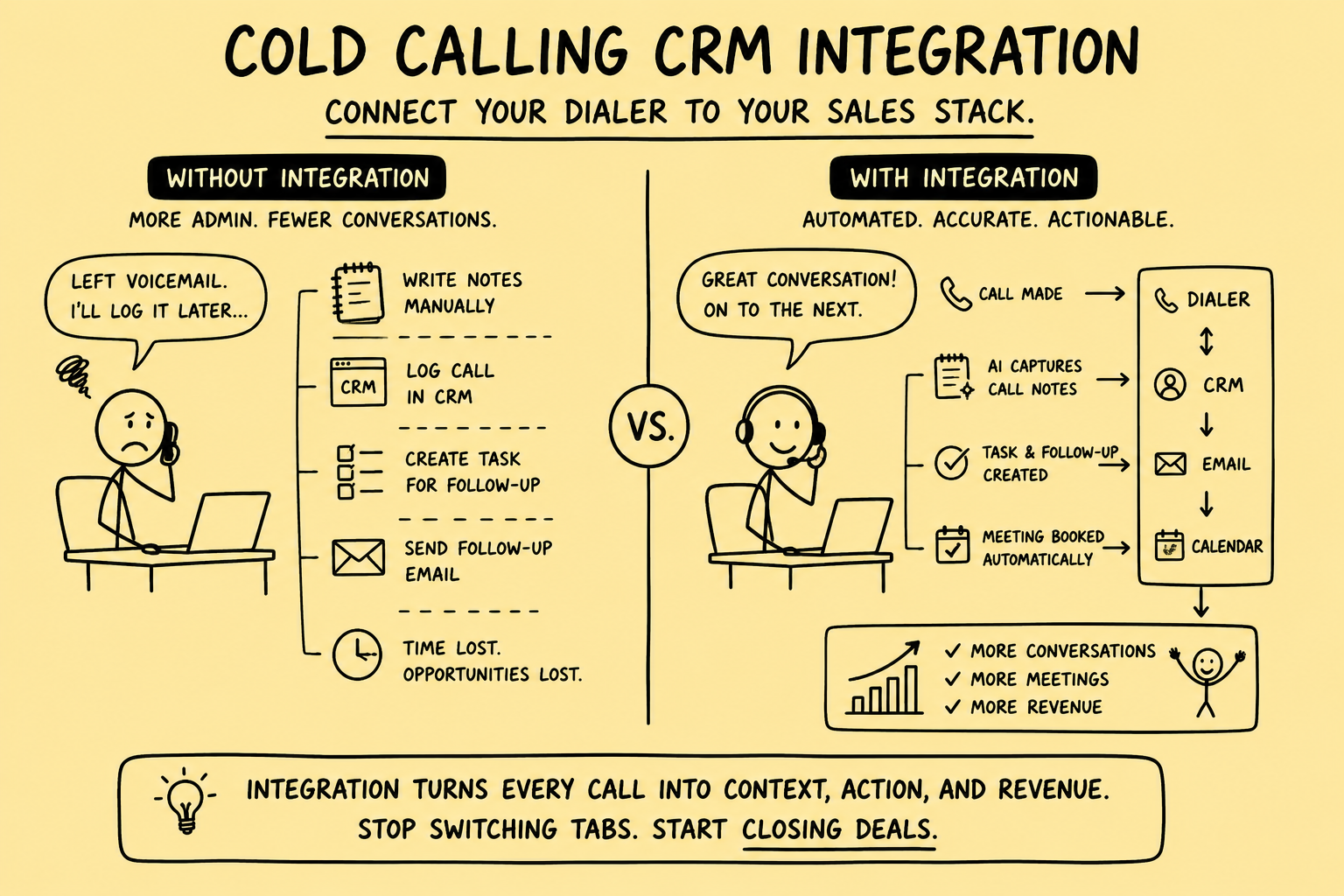
- CRM integration logs every reply, booking, and outcome automatically
- Post-reply workflows trigger next steps based on reply type — no manual tracking
With this infrastructure in place, the agency founder or BD rep spends time only on: writing the initial templates, reviewing the research notes for quality, and handling the conversations that come in. The sending, follow-up, tracking, and logging all happen automatically.
This is the model that allows a solo operator to run outreach to 300–500 qualified local businesses per month without sacrificing the personalisation quality that makes it work.
Systemify's outreach automation services build this infrastructure for agencies — connecting the email tools, CRM, and follow-up workflows into a system that runs continuously in the background.
Brokerage data stays governed. Material deal decisions stay human.
We design business broker systems around least-privilege access, documented data flows, protected credentials, traceable activity, and approval gates. Systemify does not use client information to train its own models. When a workflow uses an external AI provider, its purpose, data fields, and retention approach are documented and approved before client data is transferred.
Looking for business-broker systems?
Our current work focuses on helping business brokers build stronger buyer and seller pipelines and more controlled deal operations.
Talk to a Broker Systems Expert