
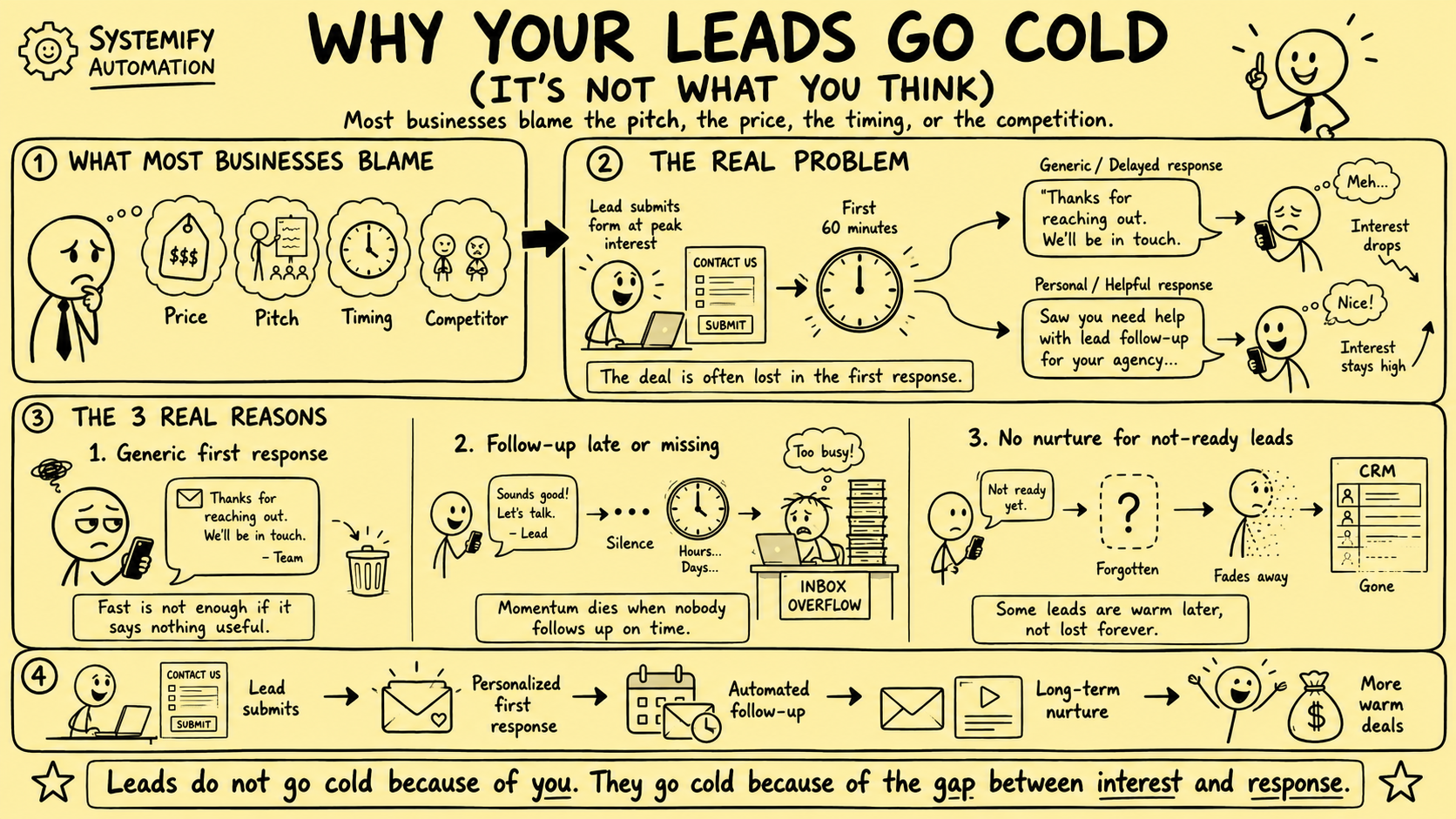
When a buyer or seller stops progressing, the CRM may show an old date and a stage such as “cold.” That is an observation, not an explanation.
This article previously claimed that most deals were lost in the first response, that prospects chose which business to engage within 60 minutes, that they submitted to multiple providers simultaneously, and that their “energy” declined every hour. It then attributed stalled records to three universal causes and promised better replies, close rates, and sales cycles from one response workflow. Those unsupported claims and obsolete service links were removed.
Direct answer: Define each broker relationship and expected transition, capture the events around every handoff, measure drop-off by comparable cohort, assign evidence-based reason codes, investigate missing data, and test one operational hypothesis at a time. Do not turn silence or elapsed time into a presumed cause.
This is operational guidance, not legal, privacy, valuation, tax, accounting, licensing, or transaction advice. Applicable duties vary by jurisdiction, channel, relationship, data, matter, and purpose. Qualified owners should approve the brokerage’s policy.
Stop calling every record a lead
A brokerage can have several fundamentally different relationships in the same system.
| Record type | What may be known | A meaningful next transition |
|---|---|---|
| Seller inquiry | Someone expressed possible selling interest | Identity and purpose verified; broker review accepted |
| Seller prospect | Ownership, timing, and basic fit are partly understood | Qualified conversation or approved next step |
| Active seller relationship | Scope, authority, and commitments are documented | Engagement milestone completed |
| Buyer inquiry | Someone requested information or made contact | Identity, purpose, and access path verified |
| Qualified buyer | Criteria and qualification evidence meet the brokerage’s policy | Authorized opportunity review or next step |
| Referral | A source introduced or identified another person | Introduction and permissions resolved |
| Live transaction | A matter has owners, deadlines, dependencies, and confidential information | Matter-specific milestone completed |
A seller inquiry that never verifies ownership is not the same as a qualified buyer who pauses after reviewing an opportunity. A referral without permission is not the same as an inbound request. A live transaction awaiting a document should not enter a marketing nurture workflow.
Use separate state models, owners, access rules, service targets, stop conditions, and reporting for each relationship. If a person holds more than one role, preserve those roles and contexts instead of overwriting them with one generic status.
Define the transition before measuring drop-off
A useful stage has an entry rule, an expected next event, an accountable owner, and an exit rule.
For each stage, document:
- The evidence required to enter it
- The next valid transitions
- Who can approve or change the state
- Which brokerage or external action is expected
- The clock’s start, pause, and stop conditions
- What counts as completion, rejection, deferral, or exception
- Which information can be used or disclosed
- Which events terminate outreach or require escalation
“No reply in seven days” is not a complete stage definition. The brokerage may owe the next action; the person may have requested a later date; an email may have bounced; a colleague may be handling the matter outside the CRM; or a confidential deal may have entered a different workflow.
Define “stalled” narrowly: the expected transition did not occur within the observation window and no valid pause, stop, closure, or superseding event was recorded. That definition makes a queue reviewable without claiming to know the cause.
Capture the evidence around each handoff
Store timestamps as events rather than repeatedly replacing one “last contacted” field.
Useful events include:
- Inquiry received and source recorded
- Identity matched, created, merged, or flagged
- Acknowledgment sent or failed
- Relationship assigned and owner accepted
- Human review started
- Meaningful response attempted, delivered, and answered
- Next step proposed, accepted, scheduled, completed, changed, or missed
- Brokerage task created, completed, overdue, or escalated
- Qualification evidence requested, received, reviewed, or rejected
- Permission, preference, objection, or suppression changed
- Matter opened, paused, restricted, closed, or superseded
- Stalled review completed and reason code approved
An automatic acknowledgment and a meaningful response are different events. “Sent” and “delivered” are different. A meeting booking and a completed meeting are different. Preserve occurred-at and recorded-at times, source system, actor, relationship, matter, event ID, policy or template version, and correction history.
These distinctions reveal whether the apparent delay came from intake, routing, ownership, drafting, delivery, scheduling, missing evidence, a brokerage commitment, or an external dependency.
Measure the whole funnel before choosing a cause
Build a transition table for every important relationship path.
| Transition | Count | Eligible denominator | Rate | Elapsed-time percentiles | Missing-data rate |
|---|---|---|---|---|---|
| Inquiry received → owner accepted | |||||
| Owner accepted → meaningful response | |||||
| Meaningful response → reply | |||||
| Reply → qualified next step | |||||
| Next step accepted → completed | |||||
| Qualified relationship → approved deal stage |
Report the denominator, date range, cohort definition, time zone, business-hours policy, exclusions, and follow-up horizon. A rate without those fields is difficult to interpret and easy to misuse.
Use medians and percentiles alongside averages. A mean can be distorted by a small number of extremely old records. Show the distribution and the unmeasured records rather than compressing the story into one number.
Do not compare unlike cohorts. Separate at least:
- Buyers from sellers
- Inbound inquiries from sourced outreach and referrals
- New relationships from active or dormant ones
- Business-hours from out-of-hours events
- Human-created from imported or migrated records
- Channels, territories, owners, sources, and service lines
- Valid delivered messages from bounces and invalid identities
- Live deals from pre-engagement pipeline activity
Use reason codes without inventing certainty
The observable fact might be “no reply after a delivered message.” The cause remains unknown unless evidence supports it.
Use reason codes such as:
- Brokerage action overdue
- Ownership or routing failure
- Invalid, duplicate, or mismatched identity
- Delivery or channel failure
- No current fit under documented criteria
- Person declined and provided a reason
- Person requested a later date
- Qualification evidence incomplete
- Permission or channel restriction
- Objection or suppression
- Confidentiality or access condition unresolved
- Matter superseded, paused, or closed
- External dependency documented
- No response; cause unknown
- Other, with reviewed evidence
Separate the observed state, reason code, reason source, recorded-at time, confidence, and reviewer. If the reason came from a person, preserve the dated source. If it is an internal inference, label it as an inference. Do not convert “no response” into “not interested,” “chose a competitor,” or “bad timing.”
Review reason-code drift. If one team uses “not interested” for any silence while another uses it only for an explicit decline, their reports are not comparable.
Treat response time as a hypothesis, not a verdict
Historical studies can make response time worth investigating. They cannot establish that every broker opportunity is decided in a fixed window.
The 2011 Harvard Business Review article on online sales leads and vendor-published Lead Response Management 2021 research concern particular online-inquiry settings, samples, methods, and periods. They are not current business-broker outcome benchmarks.
The frequently repeated response-time average traces to historical research such as the 2012 ResponseAudit report. Before reusing an average, inspect the sample, inclusion rules, distribution, median, extreme values, event definition, and relevance to the brokerage’s own inquiry types.
Test response handling with local evidence:
- Define receipt, acknowledgment, owner acceptance, meaningful response, delivery, reply, and qualified next step.
- Establish the baseline by relationship type and comparable cohort.
- Fix missing ownership, invalid routing, and measurement gaps first.
- Change one operational variable, such as assignment alerting or business-hours coverage.
- Hold the offer, qualification rule, audience, and measurement window as stable as practical.
- Compare downstream quality and harms, not only reply volume.
- Document confounders, sample limits, and uncertainty.
Faster can be useful when it improves a real service handoff. It is not permission for an unreviewed valuation statement, inaccurate buyer claim, premature disclosure, or inappropriate message.
Diagnose common failure zones
Use the evidence to test hypotheses across the entire system.
Capture and identity
Required fields may be missing, spam may enter the queue, the same person may exist under several records, or an adviser may be mistaken for a principal. Measure incomplete intake, duplicate rate, merge errors, invalid contact data, and identity exceptions.
Routing and ownership
The record may reach the wrong team, remain unaccepted, or stay assigned to someone unavailable. Measure time to accepted ownership, reassignment, unowned aging, after-hours queue behavior, and overdue internal tasks.
Response quality and delivery
A response may be prompt but inaccurate, irrelevant, undelivered, or missing a workable next step. Review representative samples for factual grounding, role clarity, claim accuracy, confidentiality, readable delivery, and alignment between the message and the recorded state.
Fit and qualification
The inquiry may not meet the brokerage’s documented criteria, or the process may request too much too early. Track which criteria were applied, what evidence was available, who decided, what remained unknown, and whether similarly situated records were treated consistently.
Process friction
Broken booking links, inaccessible forms, repeated data requests, unclear responsibilities, document failures, and long approval queues can stop progress. Test the complete path as the recipient experiences it.
Trust and claims
Generic language is not automatically the cause of silence, and personalization is not automatically the cure. Review whether the brokerage accurately identified itself, explained the purpose, avoided unsupported promises, protected confidential information, and offered a suitable next step.
Permission and channel
A record may be ineligible for a promotional message or a particular channel. The ICO guidance on respecting preferences explains objections, withdrawals, opt-outs, and suppression lists in the UK context. Silence is not renewed permission, and an objection should not be treated as a reactivation opportunity.
External timing and deal conditions
Financing, ownership discussions, advisers, market conditions, diligence, personal circumstances, or another transaction event can change the next step. Record verified context without inventing sensitive facts or presenting an external dependency as a brokerage failure.
Keep live-deal inactivity out of marketing automation
When a live deal stops moving, create a matter-specific review. Check the current milestone, owner, parties, authorizations, outstanding commitments, confidentiality status, dependencies, deadlines, and escalation path.
Do not send generic “still interested?” messages to a live seller or buyer because a marketing clock expired. Do not expose the opportunity name, financial data, valuation work, bid status, diligence material, negotiation position, or another party’s identity in a broad automation platform.
The correct action may be an internal task, a professional review, an authorized update, a secure-document request, a revised timeline, or no outbound action.
Build exception queues, not silent failure
Create visible queues for:
- New records without accepted owners
- Brokerage commitments that are overdue
- Records aging without a valid next event
- Replies without assigned handling
- Missing or conflicting reason codes
- Duplicate people or incompatible roles
- Delivered communications without source events or approvals
- Bounces, provider failures, and broken links
- Suppressed contacts with pending promotional actions
- Live deals present in generic nurture
- Confidential access that changed after a message was approved
- Corrections that did not propagate across systems
Give every queue an owner, service expectation, severity, safe retry rule, escalation path, and closure evidence. Reconcile the CRM, messaging, calling, calendar, document, and deal systems so one tool’s “success” does not hide another tool’s failure.
Use controlled tests and balanced metrics
A useful experiment changes a defined part of the workflow for comparable eligible records. Predefine the hypothesis, eligible population, primary measure, guardrails, observation period, stopping rules, and review owner.
Track both progression and harm:
- Stage-transition count and rate by relationship type
- Median and percentile elapsed time between defined events
- Qualified next steps accepted and completed
- Owner acceptance and brokerage-task completion
- Records with unknown or missing reasons
- Duplicate, invalid, and misrouted records
- Message corrections, rejections, and cancellations
- Delivery failures and repeated attempts
- Preference blocks, objections, and suppression propagation
- Complaints, confidentiality exceptions, and incident response
- Reviewer workload and exception aging
A higher reply rate is not sufficient if replies are mostly objections, poorly qualified records advance, complaint volume increases, or owners cannot handle the work. A lower response time is not a business outcome by itself.
Avoid causal language unless the design supports it. “The rate changed after the workflow changed” is an observation. Proving that the workflow caused the change requires stronger controls and enough representative data.
A practical 30-day diagnostic
Week 1: define
Choose one buyer or seller journey. Write the state definitions, valid transitions, evidence, owners, clocks, stops, and confidentiality boundary. Freeze uncontrolled field changes while the model is reviewed.
Week 2: instrument
Capture immutable events for receipt, routing, ownership, response, delivery, reply, next steps, internal commitments, preferences, and closure. Add missing-data and reconciliation queues.
Week 3: establish the baseline
Review a bounded cohort. Publish counts, denominators, percentiles, missingness, reason-code evidence, and representative quality samples. Separate operational facts from team hypotheses.
Week 4: test one change
Choose the best-supported failure point. Improve it for an eligible cohort, keep other variables stable where practical, and evaluate both progression and guardrails. Do not promise a close-rate or transaction result from a small operational test.
The practical conclusion
The goal is not to find one dramatic reason that every opportunity went cold. It is to make each handoff observable, each state defensible, each exception owned, and each improvement testable.
Separate buyers, sellers, referrals, active relationships, and live deals. Record what happened. Preserve what remains unknown. Fix brokerage-owned failures first. Respect stops and confidentiality. Then test improvements against comparable local evidence.
To design the surrounding system, review broker growth operations and operations streamlining, or request a Business Broker Pipeline & Operations Assessment.
Frequently Asked Questions
What does it mean when a broker lead goes cold?
It should mean only that a defined expected transition did not occur within a defined observation window. It does not, by itself, reveal whether the cause was timing, fit, trust, competition, data quality, a brokerage-owned delay, an external event, or a decision not to proceed.
How fast should a business broker respond to an inquiry?
Set targets from the inquiry type, stated urgency, operating hours, staffing, risk, channel, and your own measured outcomes. Historical response-time studies can justify testing faster handling, but they do not establish one universal deadline for every buyer, seller, referral, or live deal.
Which pipeline stages should a brokerage track?
Use stages that represent verified facts and accepted transitions for each relationship type. Seller inquiry, qualified seller opportunity, active engagement, buyer inquiry, verified buyer, matched opportunity, referral, and live transaction should not be forced into one generic lead journey.
Which metrics reveal pipeline drop-off?
Start with transition counts and rates, elapsed-time percentiles, aging by stage, unowned records, overdue brokerage commitments, missing reason codes, duplicate identities, failed handoffs, suppression conflicts, and exceptions. Always show the denominator, period, cohort, and exclusions.
Should a stalled record automatically enter a nurture sequence?
No. First identify the relationship, owner, last verified event, next expected action, permission and suppression state, confidentiality boundary, and whether the brokerage owes a task. A live deal or an objection requires a different response from an eligible dormant prospect.
Sources and evidence notes
Primary or first-party materials reviewed for this article. Scope and limitations are stated rather than silently generalized.
- The Short Life of Online Sales LeadsHarvard Business Review · Accessed
Historical online-inquiry research published in 2011. It supports treating response time as a testable operational variable, not a current business-broker benchmark or proof of why an individual opportunity stalled.
- Lead Response Management 2021InsideSales · Accessed
Vendor-published lead-response research with its own sample, method, and commercial context. Included as historical evidence to evaluate cautiously rather than as a universal service target.
- ResponseAudit Research - AA-ISP 2012InsideSales · Accessed
Historical source for a widely repeated average response-time statistic. A mean can be skewed by extreme values and should not be presented without the sample, distribution, median, and relevance to the brokerage being measured.
- Respect people’s preferencesUK Information Commissioner’s Office · Accessed
Current UK guidance on objections, withdrawals, opt-outs, suppression lists, and why an organization should not later contact an objector simply to ask whether they changed their mind.
Brokerage data stays governed. Material deal decisions stay human.
We design business broker systems around least-privilege access, documented data flows, protected credentials, traceable activity, and approval gates. Systemify does not use client information to train its own models. When a workflow uses an external AI provider, its purpose, data fields, and retention approach are documented and approved before client data is transferred.
Apply this to your brokerage
We can assess your buyer and seller pipeline, valuation and vetting workflows, communications, documents, controls, and handoffs before recommending what to build.
Talk to a Broker Systems Expert